Your Home Inspection Report Should Be a User Manual for the House

By Joe Boos, Certified Master Inspector and NC Licensed Home Inspector

What should a home inspection report do after you finish reading the summary? It should help you understand the house you are about to own. Defects matter. So do the systems that are working, the limitations of the inspection, the maintenance ahead of you, and the information you will need after the moving truck leaves.

I approach Realm’s reports as a user manual for the home. That does not mean an inspection replaces the manufacturer’s instructions for every appliance or reveals everything hidden inside the building. It means the report should leave you better equipped to own the place. A document that only tells you what is wrong leaves a substantial part of that job unfinished.

The report has a job beyond the transaction

During a purchase, attention naturally goes to negotiations, repairs, and deadlines. The report may become a working document between the buyer, agent, seller, and contractors. That is a legitimate use, but it should not determine the report’s entire character.

After closing, the negotiating period ends. The house remains. You still need to understand its roof, heating equipment, water heater, drainage, electrical system, and other visible components. A useful report gives that information a home you can return to.

Think about the difference between remembering that the inspector said something about the water heater and being able to find the relevant section, identify the equipment, see the observation, and understand the recommendation. The second experience is what a report should support.

Serious findings need clear priorities

Calling a report a user manual does not mean softening serious problems. A condition that presents a safety concern deserves direct language. Evidence of water intrusion deserves a clear explanation. An item needing prompt professional evaluation should not disappear among cosmetic observations.

The writing should help the reader understand why a finding matters. What was observed? Where was it observed? What concern does it raise? What is the appropriate next step? Those questions are more useful than a dramatic adjective.

A hypothetical loose handrail illustrates the point. A photograph and the words “handrail loose” identify an observation. Explaining that the rail may not provide dependable support, identifying its location, and recommending correction makes that observation useful. The report should communicate the concern without pretending the inspector has designed the repair.

Clear priorities also help prevent a long document from making every finding feel equally urgent. A maintenance item and a safety concern should not demand identical attention simply because each occupies a paragraph.

System information belongs beside the findings

Inspector examining outdoor HVAC equipment beside a brick wall.
Equipment photographs give the report’s system descriptions a concrete reference.

A house is a collection of systems. Understanding those systems helps a buyer interpret the observations within them. Equipment identification, visible materials, general configuration, and accessible operating information can provide valuable context when they are observed and documented.

That context should be specific to the house. A page of generic advice does not become useful merely because it appears in a long report. The reader should be able to connect the information to the equipment or condition being discussed.

For example, a report may document the location of an observed shutoff or identify the type of heating equipment present. That information can remain useful long after a repair negotiation. It is also different from promising that every control, hidden component, or emergency procedure has been documented.

The report should be honest about its reach. An inspection covers an agreed scope and the conditions that could be evaluated at the time. Clear limitations help a homeowner understand where the record ends and additional information is needed.

Maintenance guidance should connect to ownership

Not every observation is a defect. Some information helps a homeowner keep a functioning system in service. Other information explains why a particular condition deserves attention before it becomes a larger problem.

Those distinctions matter. A buyer should not have to guess whether the inspector is describing a current failure, routine care, a limitation, or a recommendation for further evaluation.

Maintenance guidance is strongest when it has context. A discussion of drainage becomes more useful when the report explains the observed arrangement around the house. Filter information becomes more useful when the reader can identify the equipment involved. A recommendation to obtain service records should explain what those records might help establish.

The report should also point readers back to qualified professionals and manufacturer instructions when the task calls for them. Useful guidance does not require turning an inspection report into a do-it-yourself repair guide.

Photographs and organization make the information usable

White PVC drain cleanout, surrounding pipes, floor framing, and ductwork in a crawl space.
A reference photograph shows the drain cleanout together with the surrounding crawl-space systems.

A close-up can show a condition clearly and still leave the homeowner wondering where it is. Wider reference photographs, understandable captions, and consistent locations help connect the observation to the property.

The same principle applies to organization. A reader should be able to move from a summary to the supporting observation and then find the relevant photograph without conducting a search through unrelated material.

At Realm, the report format is organized by system and supports photographs, video, maintenance information, and a downloadable PDF. Those features give the information a practical structure. The inspector still has to supply careful observations and clear writing. Software cannot do that work on its own.

A good interface makes a report easier to use. It does not excuse a vague explanation, a photograph without context, or an unsupported conclusion.

A complete sample is a better comparison than a page count

When comparing inspection reports, read beyond the summary. The summary has a narrower job. It draws attention to selected findings; it cannot show everything the full report provides.

Ask whether you can understand an observation without having been present for the inspection. Look for its location, supporting evidence, practical significance, and next step. Then look for information about the house itself, including the systems inspected and the limitations encountered.

Page count is a weak measure of that work. A longer document can contain more useful information, more repetition, or both. A shorter one can be clear or incomplete. Counting defects is no better. Different houses and inspection conditions produce different findings.

The useful comparison is what the report enables you to understand. Can you distinguish immediate concerns from ordinary upkeep? Can you find the supporting detail? Could you return to the document six months later and still make sense of it? Those are fair questions to ask of any sample, including ours.

The report should keep earning its place after closing

A home inspection report is a record of observed conditions at a particular time. It is not a warranty, a prediction that nothing will fail, or a substitute for later service records and professional evaluations.

Within those limits, it can still be an excellent starting point for ownership. Keep it with the documents that accumulate as the house is maintained: service records, repair invoices, equipment manuals, and information about later changes. The inspection becomes part of a growing record instead of a file you open once and forget.

That is also why the quality of the writing matters more to me than using same-day delivery as a selling point. A report should be accurate, understandable, and worth returning to. The buyer needs a clear account of the problems, but also a clearer understanding of the home.

When I describe Realm’s reports as user manuals, that is the standard I mean. The report should help you make the purchase decision and remain useful when the house becomes yours.

Frequently asked questions

Is a home inspection report the same as a complete home maintenance manual?

No. It records the inspection’s scope, observations, findings, and limitations. It can provide useful ownership and maintenance context, but it does not replace equipment manuals, service records, or professional advice for work outside the inspection.

Should I read the full report if I have already read the summary?

Yes. The summary highlights selected findings. The full report supplies additional descriptions, photographs, limitations, and supporting explanations that help you understand the house and the recommendations.

Does a homeowner-focused report downplay defects?

It should not. Clear safety and repair findings are essential. A useful report communicates them directly while also explaining the systems, maintenance considerations, and context that support informed ownership.
A Home Inspector Has to Be a Photographer, Too

Why does a home inspector need to be a photographer, too? Because the client has to understand the findings after the inspector leaves, and an unclear photograph can make that harder. Home inspection photography requires deliberate composition, usable lighting, accurate color, and enough context to identify the location. When I put a photograph in a Realm Inspections report, I want it to help explain the house. Merely proving that a camera was present is a low bar.

Composition should make the finding obvious

Composition is the decision about what belongs in the frame and where it belongs. In an inspection report, the reader should not have to search a cluttered image to discover which connection, stain, opening, or damaged component the comment describes.

The subject needs enough space to be recognizable. The framing should also preserve the relationships that explain the condition. Cropping a loose connection so tightly that the connected equipment disappears can remove the very information the client needs.

Traditional photography principles still help. Contrast, focus, and the placement of surrounding elements direct attention, as Canon’s composition guidance explains. A report photograph does not need to obey the rule of thirds to be useful. Putting the defect near the center can be the clearest choice. The composition should serve the explanation.

Lighting has to reveal detail

A crawl space, an attic, and a sunny exterior present very different lighting problems. A dark photograph can conceal a finding. A bright reflection can erase it just as effectively.

Light direction affects the appearance of texture and shadows. Exposure determines how light or dark the photograph is recorded. Both need attention. A flashlight aimed straight at a reflective surface may produce glare; a different angle can make the same area easier to see. Changing the light should reveal the condition accurately, without making it appear more dramatic.

A bright window behind a component can also leave the subject too dark. The answer may be a different viewpoint, additional light, or an exposure adjustment. Canon’s lighting and exposure guidance describes these fundamentals. Applying them to an inspection means checking that the actual subject remains visible in the saved image.

No photograph justifies unsafe access. If the position needed for a clearer image is unsafe or inaccessible, the report should explain the limitation.

White balance keeps color useful

White balance compensates for the color of the light illuminating a scene. Daylight, household lamps, and work lights can make the same surface appear different in a photograph. Nikon’s explanation of white balance shows why a camera’s color interpretation needs attention.

For inspection work, the goal is a faithful record. A warm or cool color cast can change how a stain, a finish, or a corroded surface appears to the reader. Automatic white balance is useful, but a result that looks noticeably different from the observed scene deserves another look.

Color is also only one piece of evidence. A photograph of a dark mark does not, by itself, establish its cause. Better white balance makes the documentation clearer; it does not turn appearance into a diagnosis.

Sharp focus and honest perspective matter

A camera can produce a perfectly sharp picture of the wrong thing. If the background is crisp and the connection being discussed is blurred, the photograph has missed its job. Focus belongs on the finding, with enough surrounding detail in focus to explain it.

A dirty lens, camera movement, or getting closer than the camera can focus can make a useful opportunity into an unusable image. Reviewing the photograph before leaving the area is less work than trying to explain an indistinct shape later.

Perspective deserves the same care. A tilted camera or a close, wide-angle view can change the apparent relationships between surfaces. A photograph can illustrate an observation, but it should not be treated as a precise measurement of slope, alignment, or size. If a measurement matters, the report needs the appropriate measurement and its context.

A close-up needs a location

The inspector remembers where the photograph was taken. The client may not have been there at all. That is the reason for contextual and reference photographs.

A wider view establishes the room, elevation, or general area. A closer view identifies the component. A detail view shows the specific condition. Depending on the finding, two images may do the work of three, but the connection between them should be clear.

My usual approach is to take a wider photograph that shows where the issue is, followed by a close-up of the actual defect. These three examples come from a Realm Inspections report. Each comparison starts with the close-up alone, then adds its matching context photograph. The close-up stays exactly the same.

Example 1: A protruding siding nail

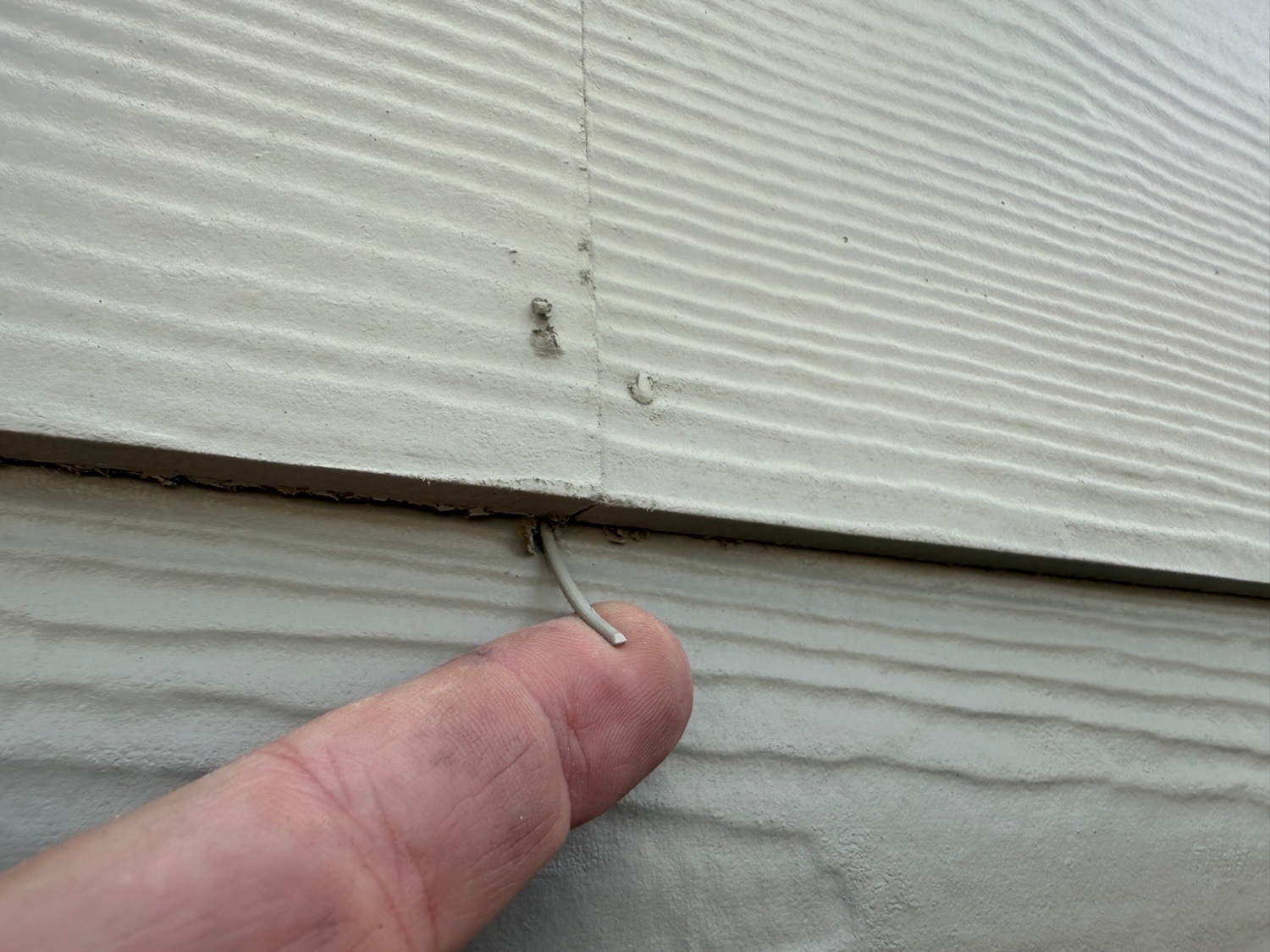
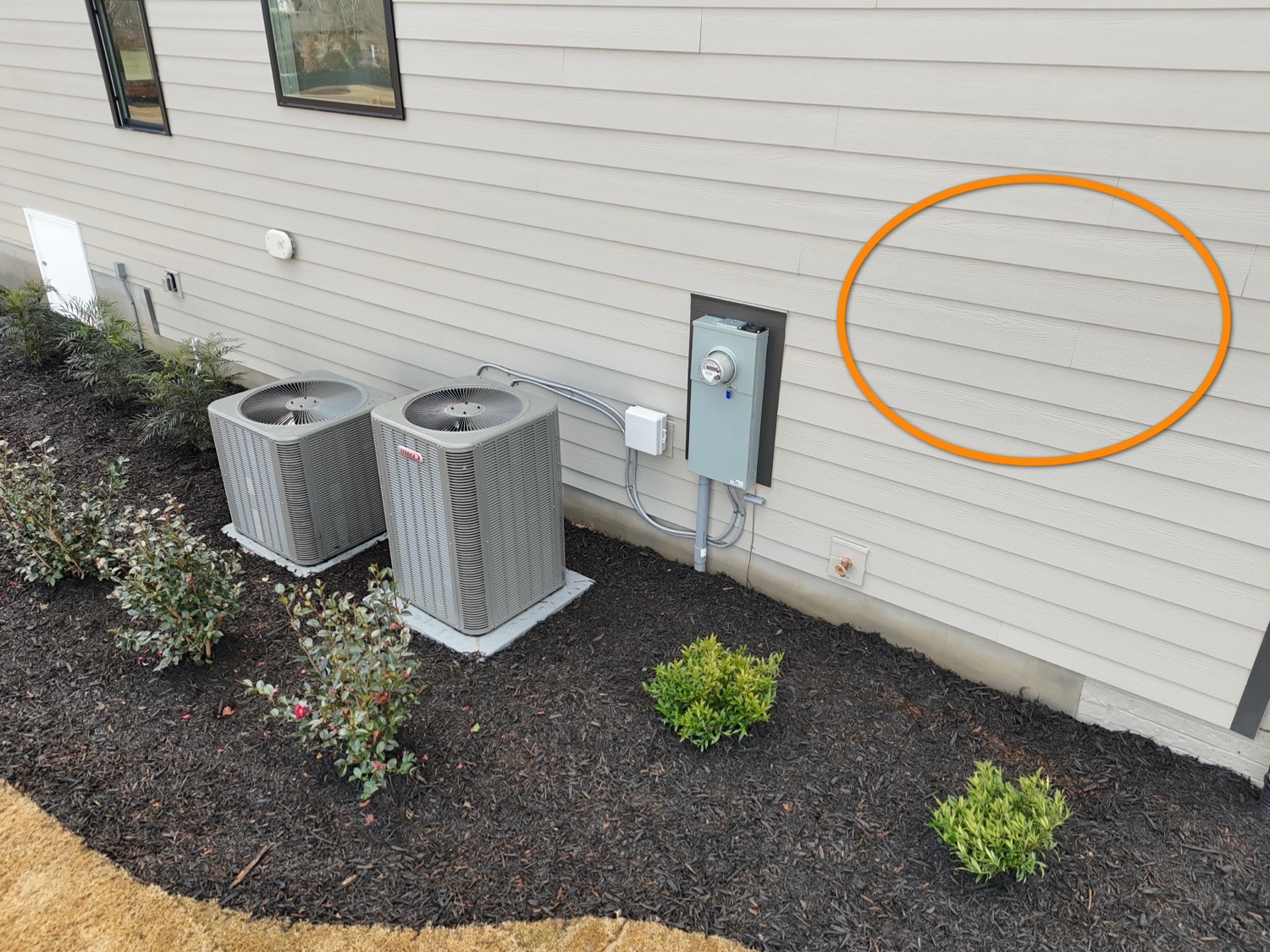
The bent nail is easy to see in the detail photograph. Finding that particular siding joint on the outside of the house is another matter.

Close-up alone: missing context

Close-up of a bent nail protruding through light-colored lap siding, with a fingertip indicating the fastener.
The close-up shows the protruding fastener, but does not establish where this siding panel is on the home.

Context + detail: a clearer explanation

Exterior wall with two outdoor HVAC units and an electrical meter, with an orange circle marking the siding area to the right of the meter.
The wider view locates the marked siding area beside the electrical meter and the two outdoor HVAC units.
Close-up of a bent nail protruding through light-colored lap siding, with a fingertip indicating the fastener.
The same detail photograph shows the bent, protruding fastener at the siding joint.

The wider view gives the reader recognizable landmarks. The written finding identified misfired siding nails and recommended evaluation and correction by a qualified siding contractor. The photographs help that person return to the right place.

Example 2: Damage to an asphalt shingle

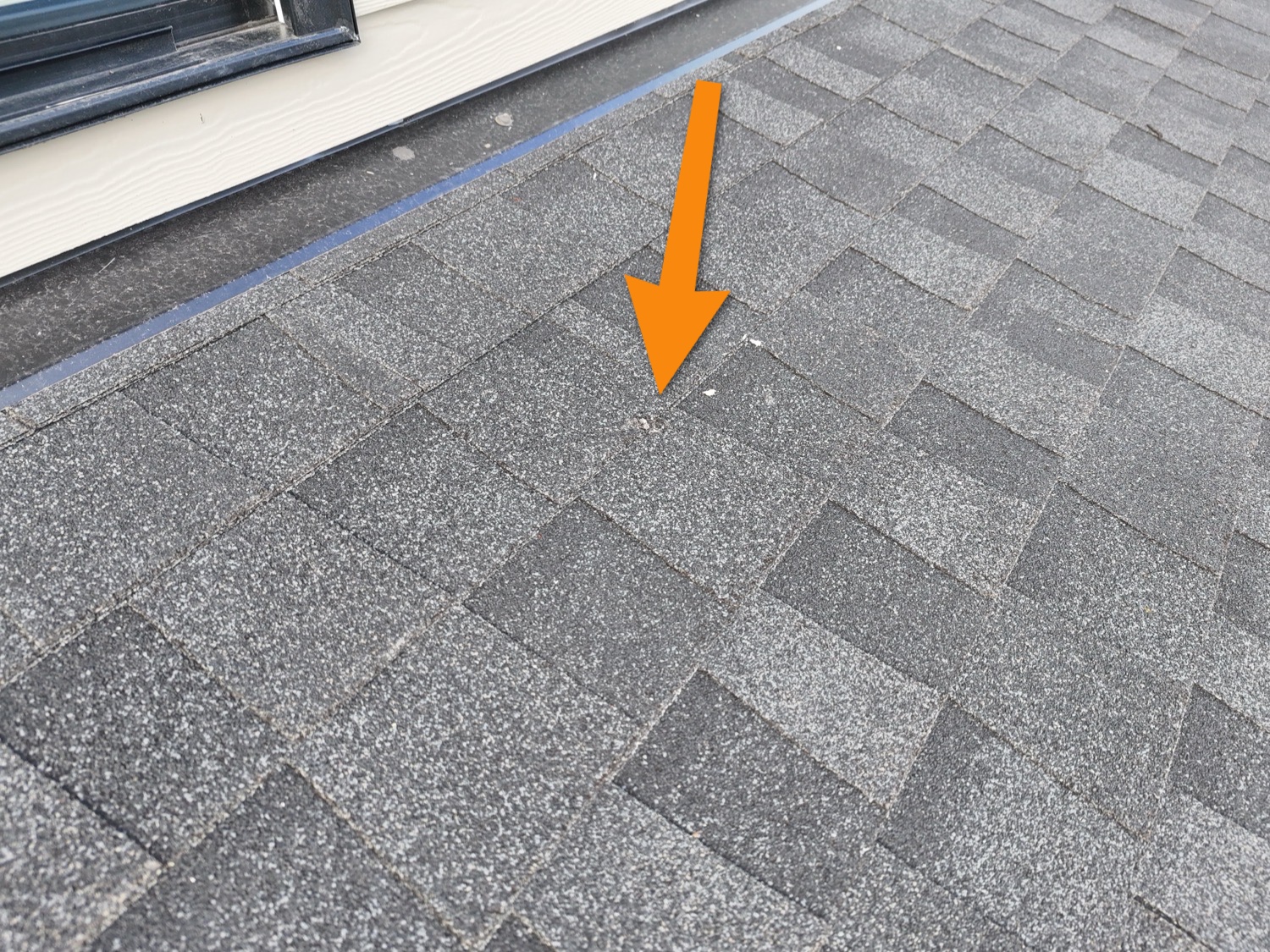
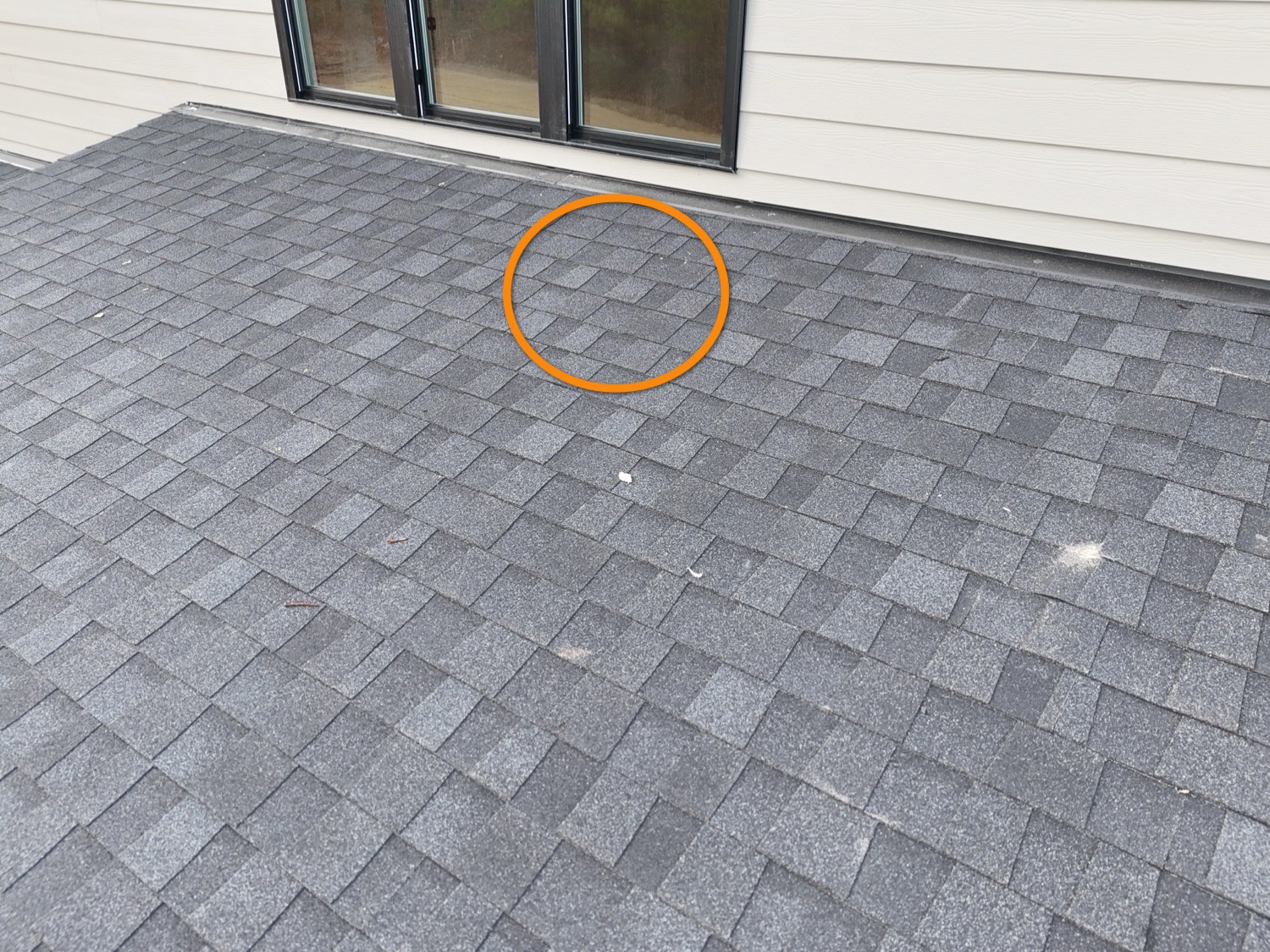
A roof contains many similar-looking shingles. A close-up can document a damaged spot without making its location clear enough to find again.

Close-up alone: missing context

Close-up of asphalt shingles with an orange arrow pointing to localized surface damage near the wall.
The arrow identifies localized shingle damage, while the tight frame leaves much of the roof out of view.

Context + detail: a clearer explanation

Wide view of a shingled roof below three windows, with an orange circle locating the damaged shingle area.
The context photograph locates the circled area below the three windows and beside the wall.
Close-up of asphalt shingles with an orange arrow pointing to localized surface damage near the wall.
The identical close-up shows the damaged shingle surface at the marked location.

The report described impact-related shingle damage and recommended evaluation and repair or replacement by a qualified roofing contractor. The wider photograph connects that small defect to a specific portion of the roof; the close-up supplies the detail.

Example 3: An unsecured shower drain cover

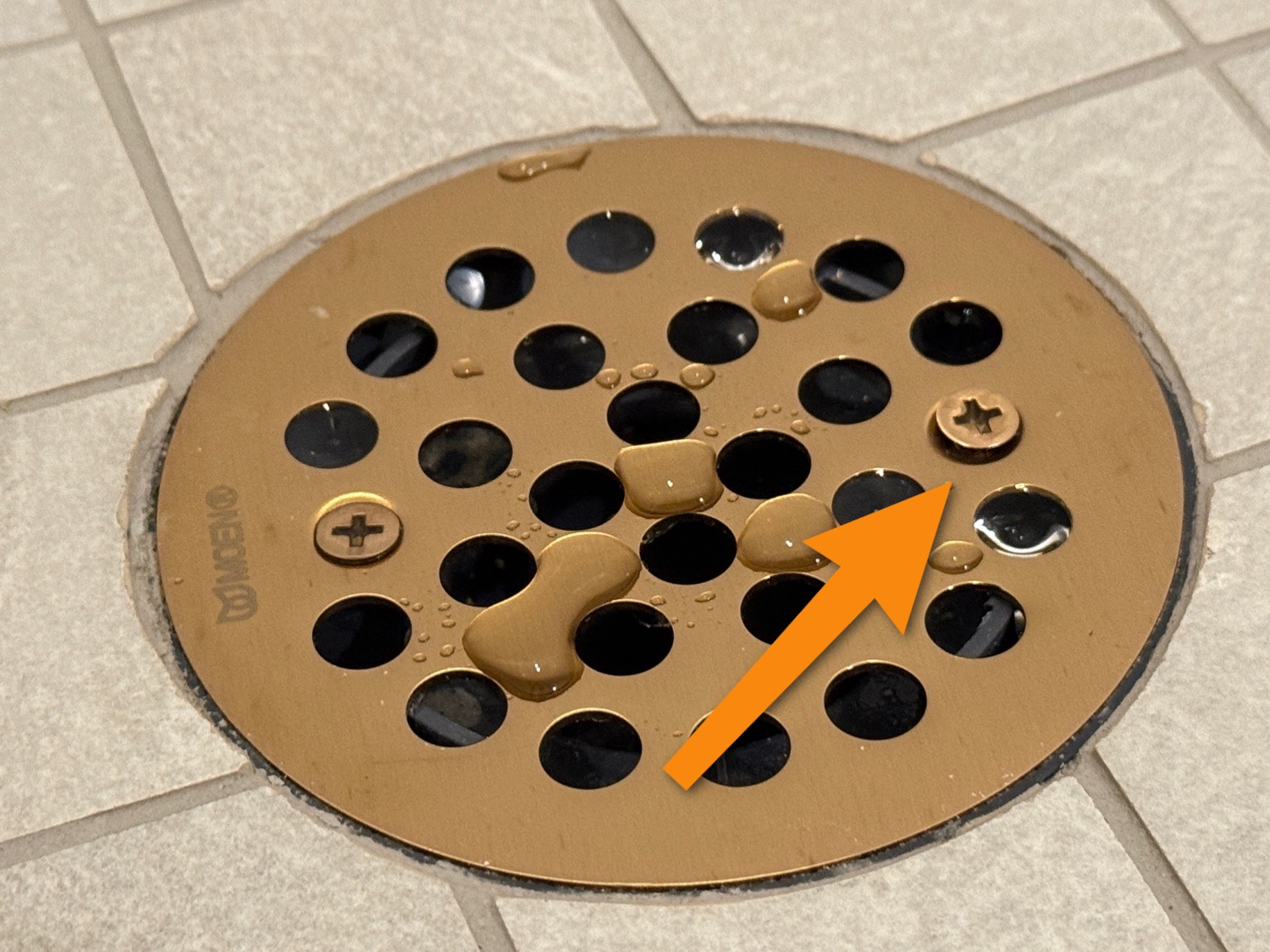
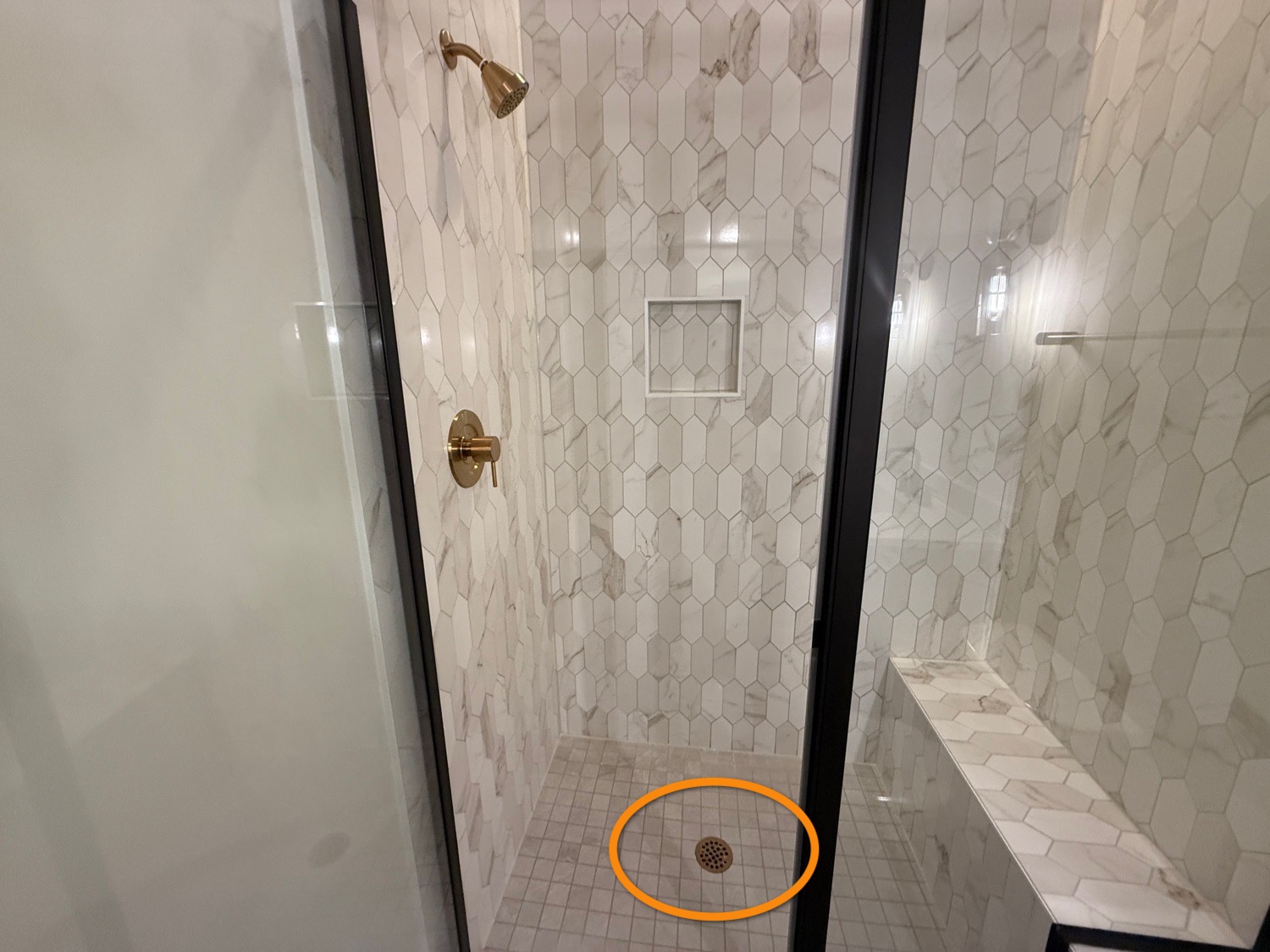
The raised screw is visible in the close-up. The wider photograph shows which shower contains that drain and how it sits within the enclosure.

Close-up alone: missing context

Close-up of a brass shower drain cover with an orange arrow indicating a raised, partially driven screw.
The close-up shows the partially driven screw in the drain cover, but gives little sense of the surrounding shower.

Context + detail: a clearer explanation

Tiled shower enclosure with brass fixtures and an orange circle locating the floor drain.
The wider view shows the tiled shower enclosure, fixtures, bench, and circled floor drain.
Close-up of a brass shower drain cover with an orange arrow indicating a raised, partially driven screw.
The same close-up shows the raised screw identified in the report.

The inspection finding documented an unsecured drain cover and a partially driven screw, with a recommendation for a qualified plumbing contractor to secure the fastener and verify the cover was stable. The still photograph supports the visible observation; the narrative records the condition found during inspection.

These are comparisons of documentation, not before-and-after repairs. A close-up is useful evidence. Pairing it with a wider view makes the explanation more complete. The original report annotations are retained, and no image details have been generated or removed.

Zooming out is often the missing step. The wider photograph may look less impressive, but it gives the detail photograph an address within the property. You can see how photographs and written findings work together in our sample inspection reports.

Captions connect the image to the observation

A caption should identify the location and describe what the image supports. In the siding example above, “Exterior wall beside the electrical meter: bent nail protruding at the siding joint” connects the location to the visible condition. The written finding then explains the concern and the recommended next step.

An arrow can direct attention to a small feature. It should not cover that feature or substitute for an explanation. If the wider and closer images show the same component, the caption or report layout should make the relationship obvious.

The wording also needs to preserve uncertainty. Showing a stain is different from establishing an active leak. Showing a separation is different from determining why it occurred. A report is clearer when its photographs and narrative make the same claim.

Editing should preserve what was observed

Rotating an image, making a restrained exposure correction, or adding a clear annotation can improve readability. The original should be retained, and the edited version should remain faithful to the observation.

Beauty filters, exaggerated contrast, and artificial color treatments have no useful role in documenting a defect. Generative edits that invent missing detail or remove evidence would undermine the purpose of the photograph. If important information was not captured, editing should not pretend otherwise.

The same judgment applies to cropping. A close crop can clarify a small finding when a wider reference image remains available. Removing the surrounding context and leaving the client to guess is a different result.

The photographs are part of the explanation

More photographs do not automatically produce a better report. A smaller set of sharp, well-lit, properly captioned images can explain a condition more clearly than a long sequence of near duplicates.

The final review should examine the photographs beside the written findings, including how they read on a phone. That is part of the report-review process, and it is visible in the way a complete inspection report presents its evidence.

A home inspector needs to recognize the condition and then communicate it. Photography connects those responsibilities. The photograph has done its job when the client can understand what it shows, where it belongs, and why it is in the report.

Sources and resources

Canon: Tips for Better In-Camera Composition.

Canon: Lighting and Exposure Fundamentals. General camera principles applied here to inspection documentation.

Nikon: White Balance. Explanation of light sources and color rendering.

Common questions about inspection photographs

Does an inspector need an expensive camera?

Equipment alone does not determine whether a photograph is useful. The image needs adequate detail, focus, lighting, and context, regardless of the camera used.

Why include a wider photograph when the defect is visible close up?

The wider view helps locate the component and shows its relationship to the surrounding area. The detail view and reference view answer different questions.

Can photographs replace the written findings?

No. Images support the description, location, significance, and recommended next step. Some operating problems and inspection limitations cannot be explained adequately with a still photograph alone.

Your Home Inspector Should Not Be Selling the Repairs

Should the company inspecting your house also sell you the repairs it recommends? My answer is no: I want the assessment of a problem separated from the opportunity to profit from fixing it. Home inspection repair conflicts matter because the homeowner needs a clear explanation of the house, without having to untangle a sales pitch. At Realm Inspections, the value I want the report to deliver is an informed decision. A list of findings should not become a shopping cart.

An inspection should not become a sales appointment

Consider a service advertised as a complete homeowner solution: inspect the house, identify the problems, arrange the repairs, and keep everything under one roof. The convenience is obvious. The financial incentive deserves equal attention.

A company that earns additional money from the work it recommends has a reason to want that work approved. That does not prove a particular finding is false. It does give the homeowner another question to resolve before accepting the recommendation.

Imagine a hypothetical moisture concern beneath a house. The client needs to understand what was observed, where it was observed, what remains uncertain, and what evaluation is appropriate. Those questions should be answered before a proposed repair package takes over the conversation. An inspection loses value when the explanation becomes a runway for the sale.

North Carolina draws a specific boundary around repair solicitation

Under 11 NCAC 08 .1116(h), a licensee cannot solicit repairs to systems or components found defective during a home inspection performed by that licensee or the licensee’s company. The wording concerns solicitation tied to inspection findings. It is not a blanket statement that every contractor evaluating potential work is violating home-inspector rules.

That distinction matters. A homeowner deserves a warning that is precise enough to use. Turning a specific ethics restriction into a sweeping accusation against every business offering several services would obscure the actual boundary.

I am concerned with the moment an independent evaluation becomes an opportunity to sell the remedy. That is where convenience needs a harder look.

A different service name does not settle the licensing question

North Carolina’s statutory definition of a home inspection covers a written evaluation, based on observation or noninvasive testing, of two or more listed residential systems or components. The Act generally requires an individual license for performing a home inspection for compensation.

The practical implication is that calling a service a home assessment, wellness visit, or maintenance review does not by itself answer whether it meets that definition. The work performed and the written product matter. A company’s preferred description does not replace that comparison.

For the homeowner, the useful question is simple: what am I actually buying? A general home inspection, a contractor’s estimate, a limited equipment service, and a maintenance visit can serve different purposes. An agreement should make that purpose understandable before anyone arrives.

Legitimate repair evaluations deserve an accurate distinction

The Board’s rules recognize project-related inspections by architects, engineers, and licensed general contractors preparing plans or estimates. They also distinguish specialized inspections connected with repair or maintenance work. Those provisions require attention to the actual service; they are not a universal exemption created by a business label.

A heating contractor looking at a furnace in order to price a repair is doing a different job from someone presenting a general evaluation of the house as independent advice. Homeowners benefit from both kinds of work when the purpose and the financial relationship are clear.

The problem is ambiguity. If the advertising promises the confidence of an independent home inspection while the appointment functions as a repair sales visit, the customer needs to ask more questions. Whether a particular arrangement violates a rule requires examination of its facts, not a verdict based on its slogan.

Disclosure should explain who benefits

Rule .1116(g) requires disclosure of potentially conflicting business interests before the inspection contract is executed and prohibits those interests from affecting inspection quality or results. Disclosure is not permission to disregard the separate repair-solicitation restriction.

As a consumer, I would want plain answers about who owns the repair business, who receives the money, and whether the inspection company benefits if I approve the recommended work. A second company name would not answer those questions for me. Neither would an assurance that everything is handled internally.

I would also want to leave with a report that remains useful if I choose a different licensed specialist. Clear locations, photographs, observations, and recommendations allow the findings to stand on their own. The client should not need to buy the next service to understand the first one.

Independence is part of what the client is buying

For a homeowner in Fuquay-Varina, Raleigh, Cary, or Holly Springs, a convenient appointment can still be useful. Convenience simply does not resolve a conflict of interest. The distinction matters whether the house is being purchased or has been home for twenty years.

My standard is that an inspection should leave the client better informed and free to decide what comes next. Our report information and sample reports show the kind of written explanation I am talking about.

A homeowner should be able to trust that a concern earned its place in the report because of the condition of the house. The prospect of another invoice should have nothing to do with it.

Sources and resources

North Carolina Home Inspector Licensure Act, particularly the definitions and licensing provisions in G.S. 143-151.45 and 143-151.50.

North Carolina Home Inspector Licensure Act and Board Rules, effective June 1, 2026, particularly Rules .1003, .1116, and .1202. Official sources checked October 3, 2026.

North Carolina Home Inspector Licensure Board: official licensing information and complaint resources.

Common questions about inspection and repair services

Does calling a service a home assessment remove licensing requirements?

The name alone does not decide that question. Compare the actual service with the statutory definition and applicable rules.

Is a contractor’s repair estimate automatically a home inspection?

No. Project-related and specialized work can fall within different provisions. The scope and purpose need to be examined.

How can a homeowner raise a concern?

Contact the Home Inspector Licensure Board with the relevant advertising, agreement, report, and repair offer so the actual arrangement can be evaluated.

Same-Day Home Inspection Reports Are the Wrong Selling Point

Is a same-day home inspection report better for the buyer? Only if it receives the careful review the buyer deserves. At Realm Inspections, I leave room to proofread and revise before delivery because the report has to explain the house clearly after I leave it. A short interval between inspecting and finalizing gives me another opportunity to check the photographs, findings, and recommendations. An early timestamp tells you very little about that work.

Fast delivery is easy to advertise

A same-day report sounds convenient. Buyers want answers, agents have deadlines, and nobody enjoys waiting for information that affects a home purchase. Timely delivery matters.

The problem starts when speed becomes the selling point and the review process disappears from the conversation. A report can arrive quickly and still leave the client wondering where a defect is, why it matters, or what to do about it. The inbox notification does not answer those questions.

There are capable inspectors who deliver thoroughly reviewed reports the same day. There are also reports delivered later that remain confusing. My objection is to treating the calendar as a quality standard. Time alone fixes nothing. What matters is whether someone uses it to examine the report before the client has to rely on it.

Field documentation and final review require different attention

Much of my report takes shape at the property. Recording observations while they are fresh is useful, and photographs preserve details that deserve a closer look. I am also inspecting equipment, moving between spaces, and answering questions. Those are necessary parts of the appointment.

The final review has a different purpose. I can compare a photograph with its caption, check whether a location is specific enough, and read the recommendation alongside the condition that prompted it. A sentence that made sense while I was standing beside the equipment may need more explanation for someone reading it at home.

Purdue University’s writing guidance recommends stepping away from a draft during revision to return with a fresh perspective. That is guidance about writing, not proof that next-day inspection reports outperform same-day reports. My practical application is to protect a separate review period before delivery. [1]

Proofreading protects the meaning of a finding

A spelling error is irritating. A sentence that changes the meaning of an observation is a bigger problem.

Consider a hypothetical bathroom finding. Writing that a toilet leaked leaves several unanswered questions. Water escaping at the supply connection, tank, or base describes different observations. If leakage occurred only when the toilet was flushed, that detail belongs in the report. So does the location, the potential for moisture damage, and the recommended follow-up.

A useful revision might read: “Water escaped at the base of the upstairs hall-bath toilet when it was flushed. Continued leakage may damage adjacent flooring and concealed materials. Have a licensed plumbing contractor complete an evaluation and repair.” That wording records what was observed without pretending the concealed cause has already been established.

This is the kind of distinction a final edit should protect. The written finding should agree with the evidence, explain its significance, and keep uncertainty visible. InterNACHI’s Standards of Practice likewise identify written reporting of observed material defects as a core part of the inspection. [2]

A clear report gives the client less to untangle

Clients use inspection reports to discuss concerns with their agents, seek specialist evaluations, and plan repairs. For buyers and homeowners around Fuquay-Varina, Raleigh, Cary, and Holly Springs, the practical need is the same: understand the actual property well enough to decide what comes next.

A review can catch a mislabeled photograph, a repeated comment, or a recommendation that is too vague to be useful. It can also reveal a mismatch between a summary and the detailed finding. Those are avoidable sources of confusion when a client is already sorting through an unfamiliar house.

Careful wording should also preserve proportion. An urgent safety concern deserves clear emphasis. A maintenance suggestion should read like a maintenance suggestion. Length and dramatic language do not make either one more useful.

Reviewing the report does not expand the inspection’s scope or uncover every concealed defect. It improves the opportunity to communicate the observations and limitations accurately. A polished document still needs to be honest about what could and could not be evaluated. [2]

A review window still needs a delivery deadline

Taking care with a report is no excuse for leaving the client in the dark. An immediate safety concern should be communicated promptly. A final written review should not become a reason to withhold information that requires attention now.

At Realm Inspections, the expectation is delivery of the reviewed home inspection report by the end of the next business day after the inspection, barring unusual circumstances. Our report information and sample reports explain that approach. Laboratory results and specialty reports follow separate timelines.

A next-business-day expectation is also different from a blanket 24-hour promise. The transaction deadline needs to be part of scheduling, with room for the client to read the report and arrange any recommended evaluations. A beautifully written report that arrives too late to be useful has missed its purpose.

The report should be ready when you receive it

The folly in selling same-day home inspection reports is allowing speed to stand in for care. A thorough review can happen on the inspection day. It can also benefit from a deliberate pause. Either way, the review needs to happen.

I want the client to receive a document that has already been questioned, checked, and clarified. The report will stay with the client long after the appointment ends. A little time spent making it clearer belongs in the service they paid for.

Sources and resources

[1] Purdue OWL: Steps for Revising. Guidance on taking breaks during revision and reviewing a draft from the reader’s perspective.

[2] InterNACHI: Home Inspection Standards of Practice. Professional context for written findings and inspection limitations. This resource does not establish a preferred report delivery interval.

Realm Inspections: Report Information and Samples. Examples of reports, the review and delivery expectation, and separate laboratory and specialty timelines.

Common questions about home inspection report timing

Are same-day home inspection reports less accurate?

Delivery timing alone does not establish accuracy. A same-day report can be carefully reviewed, and a later report can contain errors. The relevant consideration is the inspection and review process behind the document.

Why leave time between the inspection and report delivery?

A separate review period gives the inspector time to compare photographs and written findings, check locations and recommendations, and revise unclear wording before the client receives the report.

When does Realm Inspections deliver the report?

Expect the reviewed home inspection report by the end of the next business day after the inspection, barring unusual circumstances. Laboratory results and specialty reports have separate timelines.

Should an urgent safety concern wait for the final report?

An identified concern requiring immediate attention should be communicated promptly. Completing and reviewing the written report is a separate step.